Email me with comments, or for drafts or further information, at n.venkatesh@sheffield.ac.uk.
Peer-reviewed papers (single-authored)
‘Collective Impact and the Problem of Mixed Optimality’ in J. Willem, R. van Oeveren & M. Gunnemyr (eds.), The Ethics of Inefficacy, Routledge Studies in Ethics and Moral Theory. I demonstrate a common flaw in several recent proposed solutions to what Julia Nefsky calls ‘the problem of collective impact’.
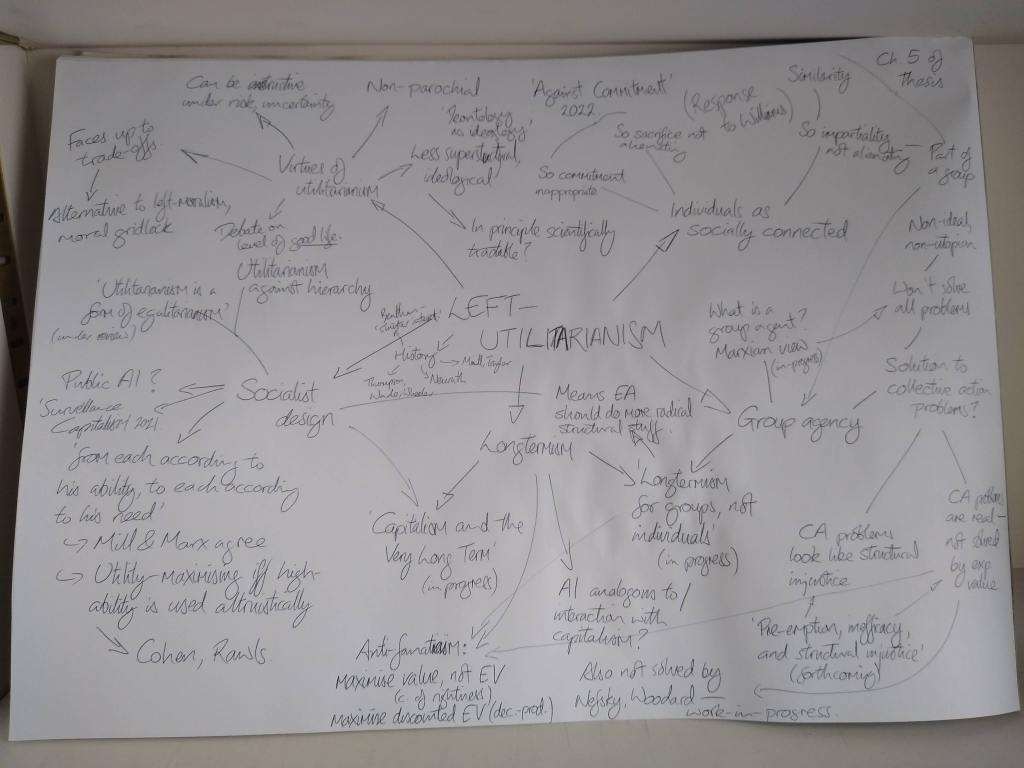
‘Utilitarianism is a Form of Egalitarianism’, 2025, Ergo: an Open Access Journal of Philosophy, 12 (27), pp. 700-725. I argue that utilitarianism shares the concerns of egalitarians for equal distributions of wealth and an end to hierarchical social relations, and further that there is no good reason not to consider it a form of egalitarianism.
‘Capitalism and the Very Long Term’, 2025, Moral Philosophy and Politics, 12 (1), pp. 33-58. I argue that capitalism has a tendency to undervalue the very far future, and therefore that those effective altruists who are attracted to ‘longtermism’ should consider embracing anticapitalism.
‘A Review of Jesse Spafford’s “Social Anarchism and the Rejection of Moral Tyranny”’, 2025, Mind, 134 (536), pp. 1218–1227. I review Spafford’s book, which makes a case for left-wing anarchism on the foundations of analytic moral theory. I enjoyed the book, but was ultimately unconvinced by its main arguments.
‘Williams’s Integrity Objection as a Psychological Problem’, 2024, Topoi, 43 (2), pp. 491-501. I offer my interpretation of Williams’s notoriously obscure objection to utilitarianism.
‘Inefficacy, Pre-emption and Structural Injustice’, 2023, Proceedings of the Aristotelian Society, 123 (3), pp. 395–404. I argue that the phenomenon of pre-emption raises a problem for act-consequentialism, and connect this with the literature on structural injustice.
‘Against Commitment’, 2022, Philosophical Studies, 179 (12), pp. 3511–3534. I defend utilitarianism against Bernard Williams’s charge that it is incompatible with commitment, by drawing on socialist thought to argue that commitment, as he conceives it, is unattractive for socially connected beings.
‘Is act-consequentialism self-effacing?’, 2021, Analysis, 81(4), pp. 718-726. I investigate whether act-consequentialism tells individuals not to accept act-consequentialism, separating this from the question of whether it would make things go better if we, collectively, did not accept it.
‘Surveillance Capitalism: a Marx-inspired account’, 2021, Philosophy, 96(3), pp. 359-385. Drawing on, but going beyond, the work of Shoshana Zuboff, I suggest that Karl Marx’s analysis of the relations between industrial capitalists and workers is closely analogous to the relations between surveillance capitalists (Google, Facebook, and so on) and users. Winner of the Royal Institute of Philosophy Essay Prize. Draft version here.
‘Repugnance and Perfection’, 2020, Philosophy & Public Affairs, 48(3), pp. 262-284. ‘Perfectionism’ – a special concern with the best things in life – is often said to be incompatible with Derek Parfit’s ‘repugnant conclusion’. I show that perfectionism is in fact compatible with it, though not with a subtly different claim, and critically evaluate Parfit’s last two papers on the subject, which appeal to perfectionism in order to avoid the repugnant conclusion.
Peer-reviewed papers (co-authored)
‘Risk, Non-Identity, and Human Extinction’, 2024, The Monist, 107 (2), pp. 146-156. Kacper Kowalczyk and I respond to a recent argument that risk-averse altruists should aim to increase the chances of human extinction. We think that would be a bad idea.
‘What Should We Agree on about the Repugnant Conclusion?’, 2021, Utilitas, 33(4), pp. 379-383. Twenty-nine authors – including me – state our agreement that the fact that a theory implies Derek Parfit’s ‘repugnant conclusion’ is not an adequate reason to reject it.
PhD thesis
‘Utilitarianism and the Social Nature of Persons’. Awarded 28th February 2023. Examined by Jonathan Wolff and Mike Otsuka. Supervised by Véronique Munoz-Dardé, Joe Horton, Ulrike Heuer, Han van Wietmarschen, and Peter Railton.
This thesis defends utilitarianism: the view that as far as morality goes, one ought to choose the option which will result in the most overall well-being. Utilitarianism is widely rejected by philosophers today, largely because of a number of influential objections. In this thesis I deal with three of them. Each is found in Bernard Williams’s ‘A Critique of Utilitarianism’ (1973). The first is the Integrity Objection, an intervention that has been influential whilst being subject to a wide variety of interpretations. In Chapter Two I give my interpretation of Williams’s Integrity objection; in Chapter Three I discuss one common response to it, and in Chapters Four and Five I give my own defence of utilitarianism against it. In Chapter Six I discuss a second objection: the problem of pre-emption. This problem is also found in Williams, but has received greater attention through the work of other authors in recent years. It suggests that utilitarianism is unable to deal with some of the modern world’s most pressing moral problems, and raises an internal tension between the twin utilitarian aims of making a difference and achieving the best outcomes. In Chapter Seven I discuss a third objection: that utilitarianism is insufficiently egalitarian. I find this claim to be unwarranted, in light of recent social science and philosophy. My responses to Williams’s objections draw upon resources from the socialist tradition – in particular, that tradition’s emphasis on the importance of social connections between individuals. Socialists have often been hostile to utilitarianism, in part for socialist-inflected versions of Williams’s objections. Thus, in responding to these objections I aim to demonstrate that socialist thought contains the means to defuse not only mainstream philosophy’s rejection of utilitarianism but also its own, and thus to re-open the possibilities for a productive engagement between the two traditions.
Work in Progress (may be available on request)
- A paper arguing that one can adopt the extreme impartiality of a moral theory such as utilitarianism without being thereby alienated from oneself
- A paper on the connections between large language models and capitalism
- A paper on act-consequentialism and trade unionism
- A paper giving a new argument for discounting very small probabilities, thereby avoiding ‘fanaticism’ in decision theory (with Andrea Petrou and Akshath Jitendranath)
My Masters thesis, on Williams’s ‘integrity objection’ to utilitarianism, is available here.
 Nikhil Venkatesh